My 4x5" Pinhole Camera





By Ian Maclellan
21 Nov 2007
I first used a pinhole camera during my eighth grade science class. We were studying optics and light and my inspiring teacher turned his office into a camera obscura similar to the work of Abelardo Morell. I liked the look and the idea stuck with me. For a few years after that I kept dreaming of pinholes and was intrigued by the pinhole work of Rob Gardiner. I was sure I wanted to work in large format but was conflicted whether to build my own(something like or ) or take the easy route and just buy one from B&H. 4x5" was the only format really in my price range so that decision was made for me. Santa Barbara's were the only cameras I knew, so that is what I got.
I got a 4x5" format, 3" Wide Angle, Baltic birch pinhole camera for $73. The Lensless Company also makes fancy varieties of four different focal lengths and a bunch of different wood types. The camera prices range from $67 for the cheapest and $423 for the most expensive 11x17" telephoto behemoth. I had used my photo teacher's at the Rockport College in Maine two years earlier. They had a Polaroid film holder, which I thought about getting but just turned out too expensive for me. I had access to a darkroom at school, so development was not a problem. I decided on sheet film and purchased four Fidelity sheet film holders.
Many people choose to make their own pinhole cameras, I didn't. I was new to large format photography and too scared to take the dive into 4x5" alone. Being able to buy a completed camera provided a steady stepping stone to keep me hooked. This camera still isn't kind, I don't want anyone to believe that, it is just easier than building your own Lego pinhole camera like Adrian Hanft of foundphotography.com.
I fell in love with my pinhole camera because of the dreamy feel of the frame, the long exposures, the strange way that the sun looks, and how completely different it is than my digital camera.
I hear about these pinhole exposure calculators online, but I have just developed my own times just by counting out times in my head, writing down those numbers with a general description of the scene, and then examining the results and adjusting my times accordingly. I consistently wrote down my exposure times in a moleskin for my first 10 to 15 exposures. After developing those I figured out what was a good exposure guess and what obviously wasn't. I have since developed an effective guessing scheme and take more consistent unmetered exposures with my Santa Barbara than with my Mamiya.
I shoot mainly Tri-X 320 film which comes in 50 packs and each sheet ends up costing about a dollar. I learned to develop sheet film two years earlier at the same and really love how relaxing the process is and have come to really enjoy and look forward the forty minutes I get to spend alone, shuffling my film.
I have not had access to a 4x5" enlarger at school, so I either make contact prints to RC postcard paper or scan them and make digital prints.
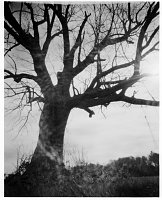
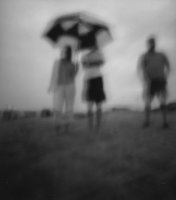
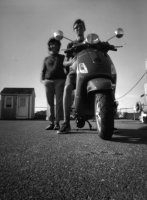
I started out taking (unsuccessfully the first few times) pictures in Boston and in my backyard. I have since expanded to some ice close ups along the Concord River, a large series on Nantucket Island, pinholes of my school's building and campus that I have incorporated into my picture of the day (http://www.groton.org/home/content.asp?id=724), pinhole portraits on my school's front steps, where I asked people passing by if they wanted to pose with different objects, and a lot of pictures of conservation land around my school.
The pinhole camera takes a lot more work than a fancy new digital camera and it is not kind when it comes to exposures. With some practice thought I think that a strong creative connection can be developed between photographer and camera. I wish I could have taken this bulky beast with me on my cross country road bike road trip, but one of its definite limitations is its size, weight, and time investment to load and safely store sheet film. I think that the Lensless Camera Manufacturing Company is doing a great service to the photographic community by making this camera affordable and making pinhole photography accessible to everyone.
3 responses
-

Steve Merrill said (23 Dec 2008):
Very nice...I have one of these too...fun, aren't they ?
-

Herschel Pollard said (11 Apr 2009):
Really nice piece. I love pinhole photography, but haven't taken any shots in quite a while. You've motivated me to break out my pinhole camera. Thanks :) Another nice camera you might be interested in is the Zero Image. It uses 120 roll film, so medium format, but really nice images.
Best of luck to you in your pinhole future :) Cheers. -

Sean-Michael Gettys said (23 Apr 2011):
I've made my own pinhole cameras, and made a rigged up pinhole for my digital SLR, but I've been seriously considering buying one or asking my Dad to buy me one for my birthday in July. This makes me want to all the more. Have you seen the Blender Pinhole Cameras? Those look really fun too! And some of them are cheaper than the one you mentioned...tho smaller. They are meant to go with 35mm and 120 film. I've been wanting a large format camera and this makes me want to make it my pinhole camera. Last but not least ... have you tried out the Positive Print Paper? It looks awesome, I'm planning to get some next month and make myself a canister camera to use it in. Sounds like you could use it in yours and cut out a step.
More My Precious Stories


More stories by Ian Maclellan


Free Print Wednesday again
Personal Post — 10 Sep 2008
First person to comment on my blog or email me asking get's a free print of mine....